Tools - Rhino.Inside.
Rhino.Inside.Civil3D embeds the full Rhinoceros 3D geometry engine and Grasshopper visual programming environment directly into Civil 3D. Drive alignments, corridors, profiles, TIN surfaces, assemblies, and sites with computational design workflows - without file exports, coordinate misalignment, or context switching.

Developed in official collaboration with Robert McNeel & Associates
Creators of Rhino 3D, Grasshopper, and the open-source Rhino.Inside® technology.
Help shape the roadmap. Rhino.Inside.Civil3D is an active open-source initiative. We encourage you to join the community to report issues and suggest features for the next release.
Quick Start
Once installed, the plugin integrates natively into the Civil 3D interface. Follow these steps to begin your first session.
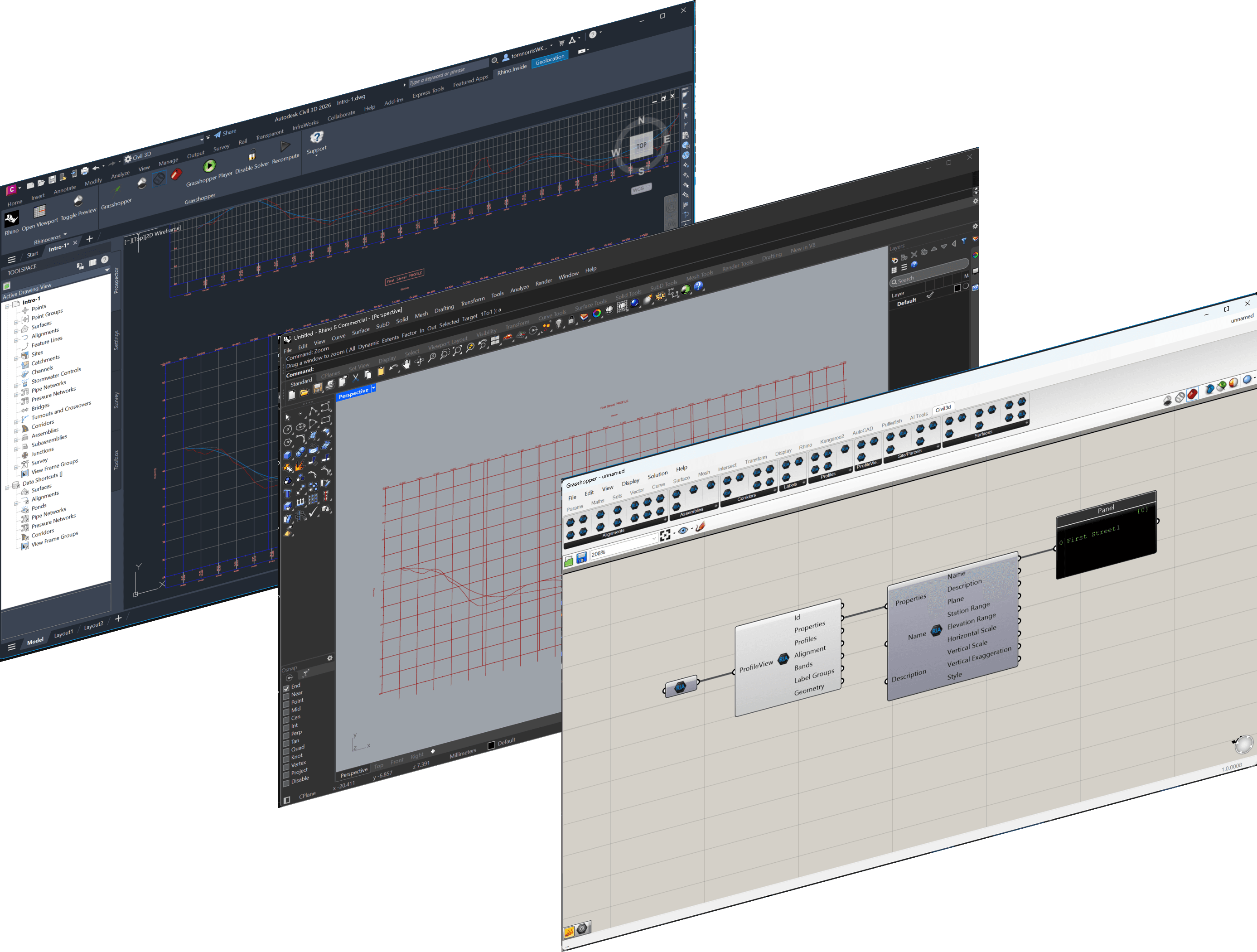
Key Capabilities
Access the full power of Rhino and Grasshopper without leaving Civil 3D. Build parametric definitions that drive alignments, corridors, profiles, and TIN surfaces directly from your design files.
Core Features
- Full Rhino Geometry Engine. Access Rhino's complete NURBS modeling kernel from within Civil 3D, including surface analysis, curve operations, and mesh tools.
- Civil 3D Object Access. Query alignments, profiles, corridors, assemblies, TIN surfaces, sites, and parcels through dedicated Grasshopper components.
- Computational Infrastructure Design. Drive alignment, profile, and corridor geometry parametrically - useful for rail, highway, and earthworks studies.
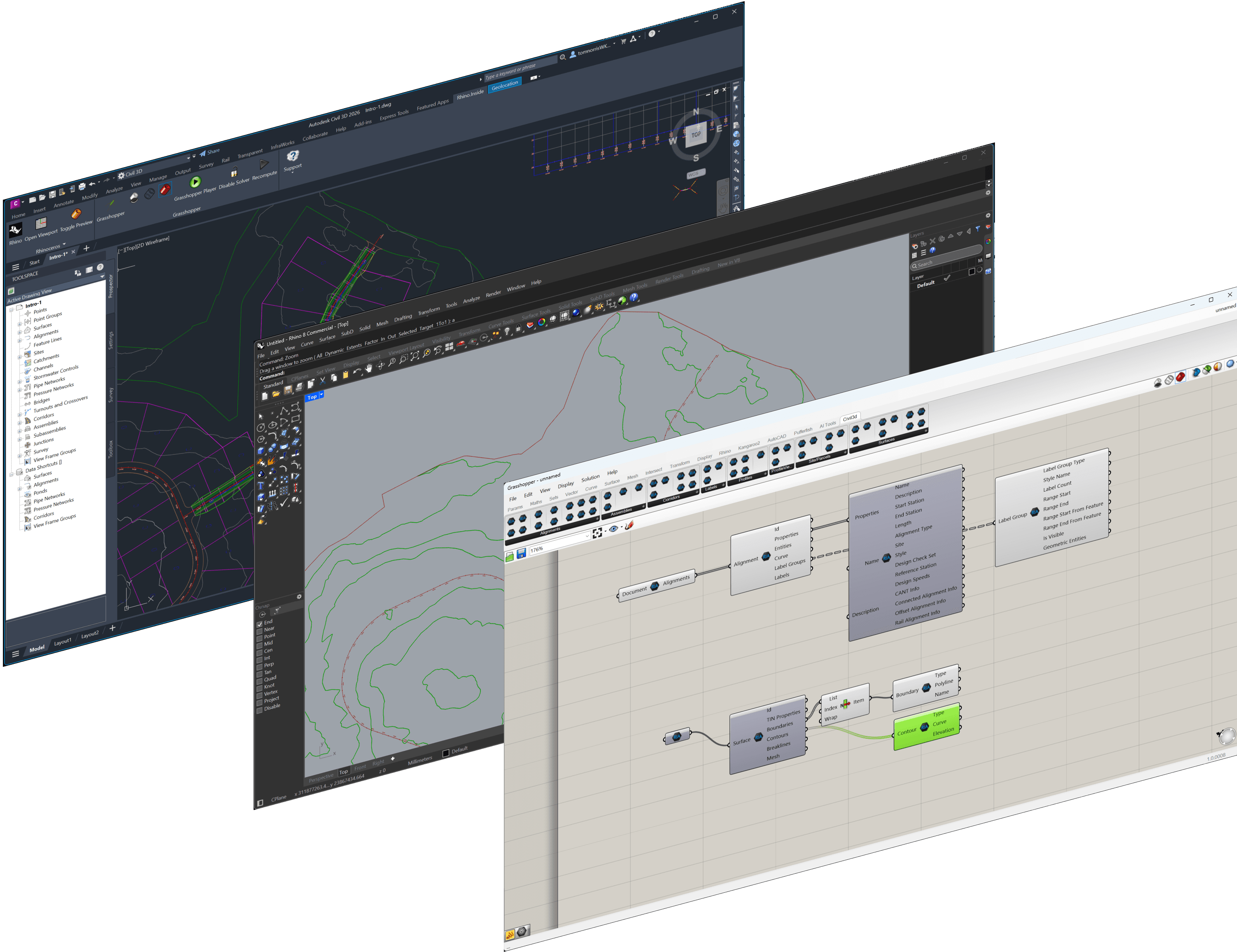
TIN Surfaces and Object Exchange
Create Civil 3D TIN surfaces directly from Rhino meshes, and decompose existing surfaces into their boundaries, contours, and breaklines for downstream analytical workflows.
Surface and Geometry Access
- Create TIN Surfaces from Meshes. Convert analytical Rhino meshes into native Civil 3D TIN surfaces, including TIN volume surfaces for cut/fill studies.
- Decompose Surface Geometry. Extract surface meshes, boundaries, contours, and breaklines for computation and visualisation in Grasshopper.
- Alignment-Driven Workflows. Create alignments from Rhino curves, extract station data, and access CANT, design speeds, rail alignments, and offset alignments.
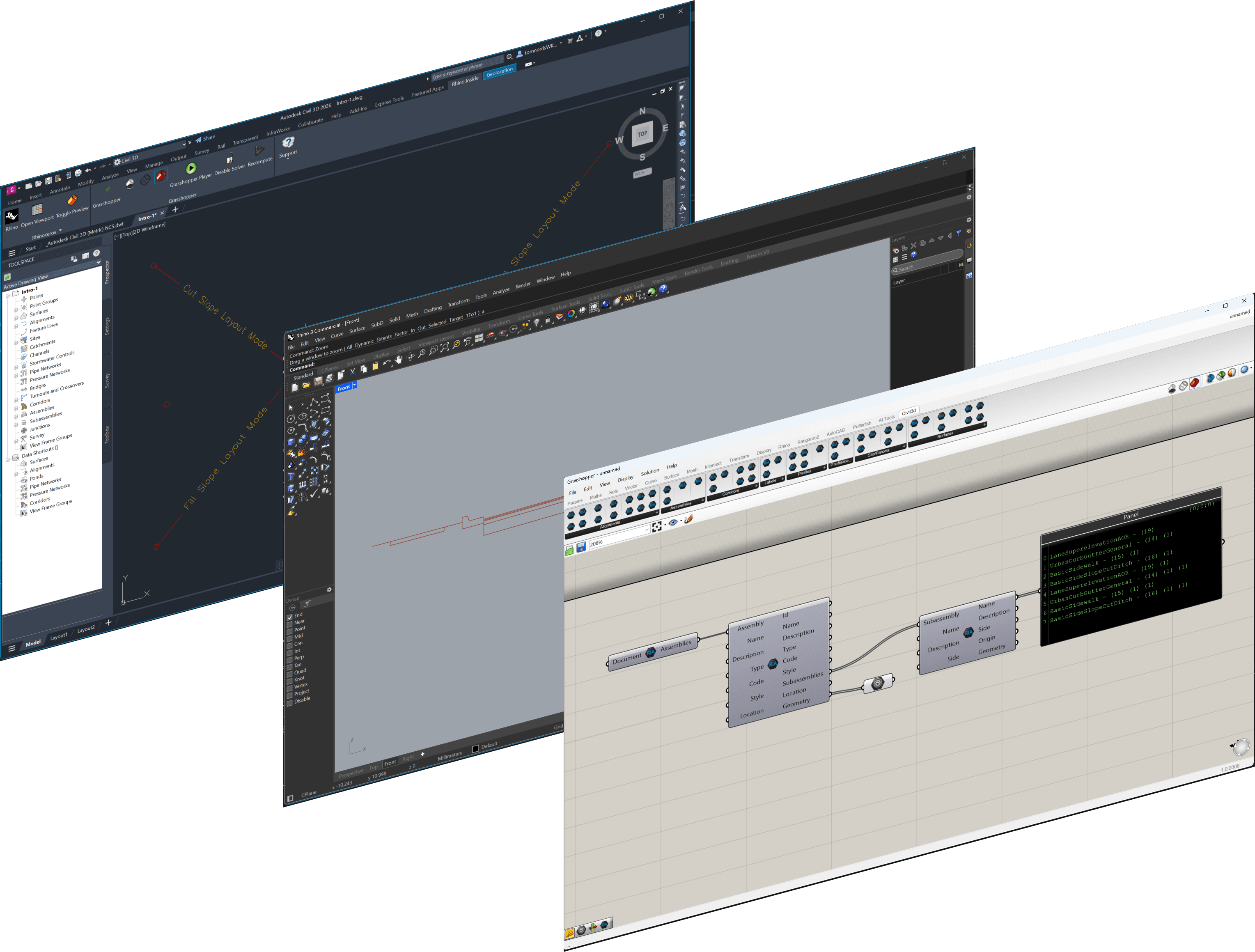
Decompose Linear Infrastructure
Decompose corridors into their baselines, regions, feature lines, and surfaces, and inspect the assemblies and subassemblies that define their cross-sections.
Corridor & Profile Access
- Corridor Decomposition. Read corridor baselines, regions, feature lines, and corridor surfaces, and extract the combined corridor mesh geometry.
- Assembly & Subassembly Inspection. Get assemblies from the document and decompose subassembly geometry and property data for downstream computation.
- Profile & Profile View Access. Extract profile entities, generate 2D station/elevation curves, and read profile views, bands, and label groups.
Technical Reference - Core Concepts
Rhino.Inside.Civil3D loads Rhino's geometry kernel directly into Civil 3D's process space. This architecture eliminates file-based workflows and enables real-time geometry exchange between both applications.

How It Works
Rhino and Grasshopper run directly inside Civil 3D, so there's no need to export or import files between applications.
Key Benefits
- In-Memory Geometry Transfer. No intermediate files; geometry flows directly between applications.
- Unified Coordinate System. Both applications operate in the same coordinate space with automatic unit conversion.
- Native Civil 3D Object Access. Grasshopper components read and write Civil 3D objects directly - alignments, profiles, corridors, surfaces, and more - within a single definition.

From Grasshopper to Civil 3D
Geometry created in Grasshopper exists in memory until explicitly "baked" to Civil 3D:
- 1.Create - Generate geometry using standard Grasshopper components
- 2.Convert - Transform Rhino geometry into Civil 3D objects (alignments, surfaces, etc.)
- 3.Configure - Assign styles, names, and associated sites via Bake Settings
- 4.Bake - Commit objects permanently to the Civil 3D drawing
- 5.Track - Receive ObjectIds for downstream operations
Resources & Support
Read the documentation, explore the source code, and connect with the community.
Documentation
Your starting point — a dedicated Civil 3D section (alignments, profiles, corridors, surfaces and more), plus installation, the Grasshopper workflow and baking guides.
Community Support
Engage with the development team on the official McNeel Discourse. Get direct support and share workflows.
Source Code
Contribute directly to the official McNeel repository. Review source code, track issues, and submit pull requests.
Need a custom Rhino.Inside implementation for Civil 3D?
We build custom integrations of Rhino.Inside, Grasshopper definitions, and Civil 3D automation tailored to your specific infrastructure. We'll start with a short, no-obligation discovery call.